Mom Wisdom: See, I wouldn’t like that

My mom has much wisdom, and it is often compressed into a succinct statement. One such statement is the beautifully versatile, “See, I wouldn’t like that.”

It is a thoughtful, personally disclosing and completely nonjudgmental response to all sorts of statements and behaviors. 

A distant relative has gotten an uncomfortable looking piercing. See, I wouldn’t like that, having a hole in my lip. But it’s not my lip.

Another family member is an avid hunter, while she is a vegetarian. See, I wouldn’t like that. But I’m sure it’s good to save money on food and of course the poor animal had at least a better quality of life while it lasted than those poor animals trapped in commercial stalls.

An elderly family member is planning a hiking and camping trip in the mountains. Well, good for her, but I wouldn’t like that. I’m sure she’ll have fun.

She will not pretend to agree with an opinion to keep the peace; she will not be abrasive or confrontational about it, either. She will not pretend that she, too, would want to skydive or travel someplace with large insects or otherwise engage in activities that she finds unappealing. She will listen, ask lots of questions, show genuine interest in the topic, seek to understand the other person’s enthusiasm, be encouraging and may also remark, well, see, I wouldn’t like that.

We have, to some extent, adopted this expression. Even when making an observation about something, such whether to go to the local First-Friday concert when the music is not a genre we enjoy, no criticism is necessary, just the agreement that lots of people will really enjoy it but, see, we wouldn’t like that.

I wonder what changes would ripple out if more people, instead of criticizing others for thinking or doing differently, the first stance was that respectful curiosity followed by a personal reflection that has nothing to do with whether the other party is “right” or “wrong.”  The alternative is a world where people fight or even cut one another out of their lives for matters that are more personal opinions than principles and too often, too little effort is made to find some common ground. And, see, I wouldn’t like that.

Why Ask Me That? Third in a series on questions in the therapy room

Someone who is struggling with anxiety just wants to feel better. It’s understandable; anxiety feels awful. The physical symptoms, so often hovering just below full-blown fight-or-flight; a mind that won’t rest, a brain that hops from topic to topic like a rabbit in a vegetable garden. Add to this the fear that so many people have when they come to therapy:  will the therapist tell me I’m crazy?

No; no, I won’t tell you that, but I am probably going to annoy you with a lot of questions that may seem to be irrelevant to your suffering. My paperwork asks about your history, decade by decade; your losses; job satisfaction; health issues; your alcohol and drug use; your prescribed medications; your exercise and sleep patterns. I ask about screen time, social memberships, supportive relationships. I ask a lot of questions, and I can tell who thinks those questions are irrelevant by who leaves them unanswered, handing me incomplete paperwork and acting surprised when I follow up on the many blank places.

All these questions are important, and here’s a short discussion on just a few aspects and the explanation.

Your sleep patterns, and any difficulties, can both contribute to, and be worsened by, anxiety, stress and depression. If you need more, or better sleep (and most people do), figuring some ways to improve your quality and quantity of sleep can help across many categories of your life: focus, memory, energy, stress level, and mood. When these improve, relationships can often improve, as you might expect when you can pay attention and be less cranky.

If you have major health conditions that are not properly managed, these may contribute to problems with sleep, anxiety, or mood. For example, poorly managed diabetes, besides being physically very dangerous, impacts focus and mood. I would refer you to your physician to see if there are problems that require medical attention.

Social isolation is a recipe for loneliness and depression. Social media use tends to make this worse – something that seems weirdly contradictory. Lonely people eventually withdraw, and this creates more loneliness, isolation and possibly anxiety and depression. We need to explore ways to enter back into activities with others.  From my guidance counselor days: children who are isolated suffer. If you ask a child if s/he has friends, and then ask him/her to name those friends, and there is a flash of hesitation, you know you are dealing with a child suffering social isolation. Just so, adults who cannot identify some supportive relationships and what is good about those relationships is an adult who is emotionally isolated.

I ask questions that make sense to me; if they don’t make sense to you, please ask why I’m asking. Thanks!

Why Ask Me That? Part 1 of a Series on Questions in the Therapy Room

“It’s a lot of paperwork.” 

Yes, I agree, it is. And all that information is helpful and useful for me in what I presume is a shared project: making positive change in some aspect – or many aspects – of that client’s life. 

The number of people who simply skip sections, as if they were optional, or not relevant, is significant. This gives the opportunity to have some conversations about those questions, and their relevance.

For example:

If someone routinely shortchanges their sleep, health problems will develop. In the short term, irritability (which tends to mess up personal and work relationships), less efficient short-term memory (ditto), distractibility (ditto) and impulsivity (mega-ditto) are possible contributors to whatever the primary complaint may be.  So maybe we should address that, too!

If you are extremely extroverted and are working remotely and living alone, you have created a perfect petri dish for restlessness, depression, and dissatisfaction. Those are psychological and emotional factors that create problems across domains. Deliberately arranging adequate real interactions with others will be essential to meeting that basic need.

If you don’t have five or six people who you can identify as part of your social support system, such as friends, family, a mentoring colleague, etc., there may be a heightened risk for depression and anxiety.  That doesn’t mean you confide personal problems with all those folks; you might have someone who provides support and encouragement in career-related areas, some people you can pray with, people who you play sports or exercise with and enjoy lighter conversations.

There are no questions on my paperwork that are not rooted in helping the client and me have a grounded understanding of the client’s strengths, struggles, and emotional resources for making positive change. Just ask me.

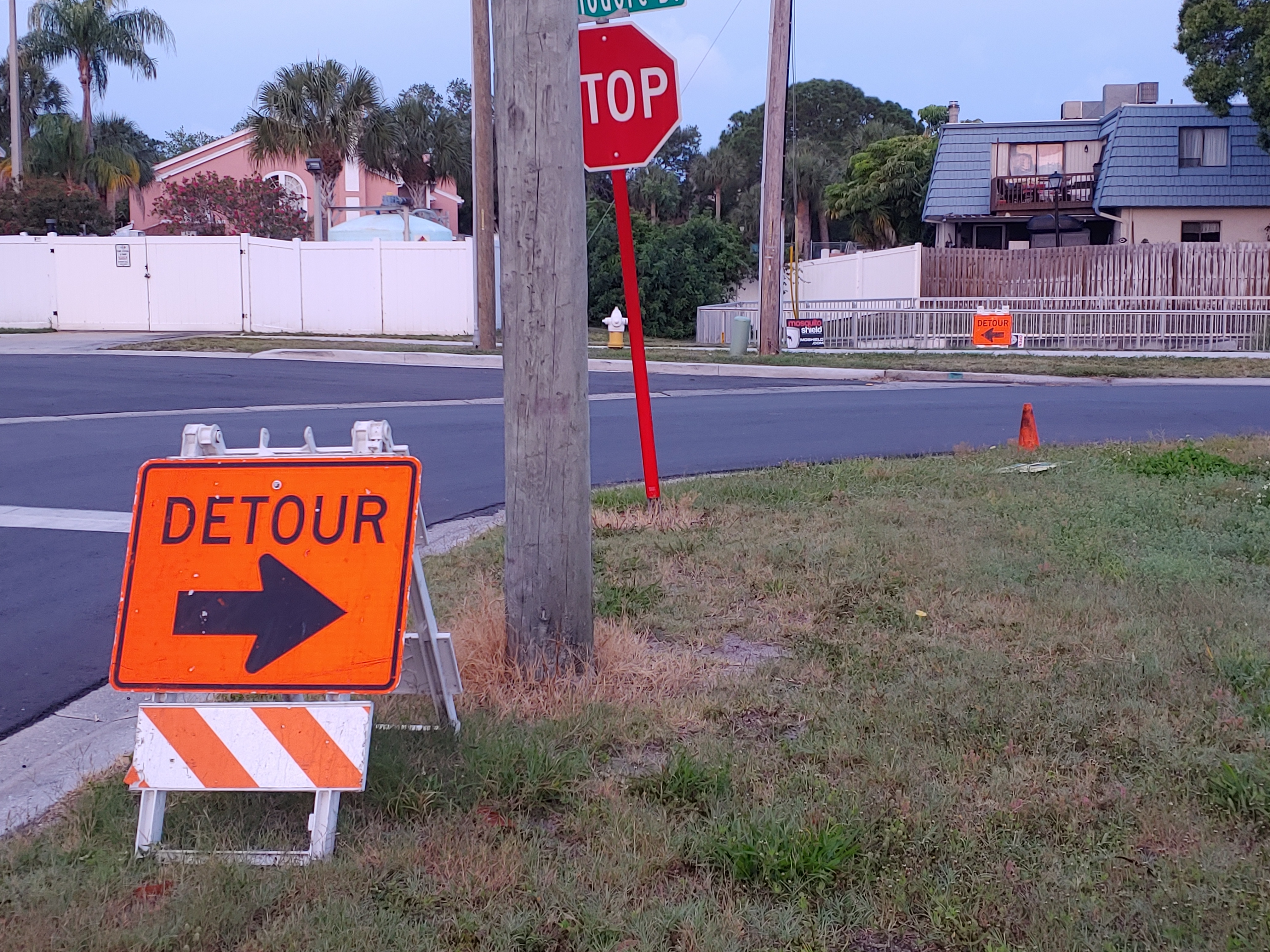
Detour Ahead. There. And there.

Look carefully. Yep, that’s a detour sign, pointing to the right at the T-intersection. And yes, across the street is another detour sign, pointing left. There are, as it happens, only two ways to choose here – right or left. Both appear to be detours. To where? From where?

A quarter-mile away, the road crews who neglected to pack up these signs (months have passed) also left behind a Detour sign with an arrow pointed up, as in, go straight ahead. That particular sign has been moved back and forth, one day pointed north, then south, and, most recently, either whimsically or horribly, as if the detour was to crash through someone’s side fence into their backyard.

Pity the unsuspecting rideshare driver who has to figure all this out. Eventually, there will be road work in our area again and we’ll all stupidly ignore the first detour signs, because we’ve learned to regard orange signs with arrows as signifying nothing.

There you go: life with crazy detours and places where there seems to be no right answer. At least, there seems to be no easy answer. It can be hard to know if a detour indicates something to be avoided or a relic or even a ruse.

Anyone new to the neighborhood would be stymied by the mixed messages, while the people who know the origin of the dueling detours shrug and ignore them – or, in some cases, get annoyed and move signs across the street.  There’s a clue: when a detour arises, ask questions; see how other people are responding to the apparent detour, and why.  On occasion, I see, in stores, the relics of the social distancing recommendations of 2020, those half-peeled away stickers on terrazzo floors. Like the road-sign-weary denizens of my area, shoppers ignore signs that used to be treated as if they’d come down from Mount Sinai.

There are detours that make sense, like when there’s a big hole in the road. No doubt you’ve gotten your share of detour signs from life. I’ve had mine. Some have kept me from disaster, and some turned out to be less about danger and more about someone else’s fears or agendas.  I’ve heard about many – and about so many people who figured out which detours were legitimate, and which were either relics or ruses.

Wishing you good adventures, and the wisdom to know relics from ruses, as well as to never be the person who puts up fake detour signs for others.

To Ink or Not to Ink

To ink or not to ink: that is the question.

Not my question, but a lot of people debate this. Perhaps they are considering the latest news: the research showing a significant increase in the risk of blood cancers with just one tattoo. That seems worth attention.

Sometimes, people planning a tattoo want to talk about it, the image and the expected arguments from friends or family. We might discuss the option of wearing a piece of jewelry with the same design for a year straight – no exceptions – or the benefit of a trial run with temporary tattoos for a few months.  Perhaps pulling out a particularly unflattering photo, with a hairstyle and clothing you thought looked great at the time, and facing it every day for a year or so would provide a tap to the brakes. Most often in these conversations, I simply listen, ask a lot of questions, and offer my personal explanation as to “why not.” There are three significant reasons.

On my phone, I have a photo of memorial bricks that rest in Europe, with the names and deportation dates of family members who died in Auschwitz in 1944.  They would have been tattooed by the Nazis, each with a unique number, for the obsessive record-keeping for which the Third Reich was known. Out of respect to their memories, no ink.

I can’t think of any sort of decoration I wouldn’t tire of, sooner, probably, rather than later. A look at my hair and fashion choices in old photos makes that spectacularly clear. Due to the likelihood that I will someday find my décor of the day regrettable, no ink.

Finally, the two most significant factors in my life, my faith and my marriage, are too important to me for tattoos. Both deserve a deliberate, mindful choice – every day, every moment. The crucifix I wear is by choice, never mindlessly or without reverence for its meaning and the demand placed upon me, however poorly I may live out that demand. The wedding ring is deliberate, a clear statement of, I love you, I choose you, each day. Never indifferent, never nonchalant: to wear these things is a daily action verb.

Now, those reasons may make no sense to you. Maybe they seem silly or irrelevant to your situation. Perhaps they do; but perhaps they are worth a conversation with someone as you, or they, make decisions about permanent records of this particular spot in place and time.  

What’s in your backpack?

I was speaking with someone reluctant to make any sort of commitment to a small change in the routine. Things were not going well for my friend, and the future seemed murky. With no clear picture of “where the journey is heading,” taking any first step seemed imprudent, my partner in conversation asserted; it would be better to wait until the “where” is sorted out in life before making a concerted effort in any direction.

One reasonable response to that is, there is no “standing still” in life: attempting to stand still just means things around you will change while you pretend you can hold your position.  See how that works for you standing in the ocean. Maybe that seems trite; the whole “you never step into the same river twice” trope that is, as it happens, absolutely true.

Another way of looking at my friend’s dilemma is this: no matter where my journey is going, some items always go in the backpack. I may not always need the water purification straws, or the sleeping bag rated for freezing weather, but I always need underwear and socks. I always need a spare pair of contact lenses and sunscreen. I always need a small Bible. I always need chocolate and my thyroid medicine. Even without knowing where, or when, I’m going, some things can go into the backpack.

No matter where your life journey is taking you, wouldn’t it be helpful to have a better quality of sleep? More physical energy?  A firmer sense of what your values are, and why, and what the implications are for daily life? A little less messiness in the closet or refrigerator or your car? Less weird clutter and mysterious crumpled papers in that one drawer? Some better thinking habits, whether it’s taking on a phobia or developing your capacity for focused attention?

Even if you’re feeling really stuck – a lot of pressures, an unhappy job situation, the first year or so into significant grief – perhaps there is one small thing you can do first– something you can “put into the backpack” – without a clear picture of where you hope to be heading. And, as you’re putting those essentials into your pack, perhaps the mystery of the next few steps on the journey will begin to come into focus.

Happy trails –

Life-Changing Hacks

Confession: I really dislike the term “hack.” It sounds awful, like a data breach somewhere, drenching the dark web with the personal info of thousands of people. It also used to mean someone whose work was poorly done and usually rushed, or the work itself. Somehow it became slang for “something you can do to make things easier/simpler/better.”

So be it, then.  In the spirit of openness (in which I score extremely high in personality tests), here are seven “hacks” for a happier life:

  1. Spend at least 15 minutes a day sitting in silence. For me, it is prayer time. This is a powerful early-day practice. If you are religious, this is a good time to sit with Scripture, a devotional book if you use one, and a small notebook in which to write a brief response as part of your prayer. For some people of faith, opening with a short Scripture reading and sitting silently in a contemplative mode of prayer is better.

If you are not religious, use it as quiet meditation time, focusing on breathing in a way that feeds relaxation and focus.

Why it works:  The research on the benefits of such a meditative practice is robust: brain health, heart health, reduced depression and anxiety symptoms. For people of faith, it becomes an opportunity to listen and reflect on God’s presence in their lives and how they are called to live. Taking a few moments to formulate your thoughts and write to God can help anchor you into the experience. The act of writing – words of gratitude, questions, fears – helps with focus and invites you to be in dialogue.

  • Go on a news fast.  If something horrible that actually requires your attention happens or is imminent, like a hurricane or other disaster, you’ll find out about it. Otherwise, just skip the news for a week, or two, or more. Then titrate your dosage:  15 minutes a day, checking into two or three varied sources.

Why it works:  repeated exposure to what are often the same events, or people discussing those events, has the neurological effect of repeated distressing experiences and amplifies your stress level. By quickly reading, rather than watching and listening, you will be better able to glean information without being overly stimulated emotionally.

  • Once a week, avoid all electronics except:
    • Live interaction with loved ones at a distance
    • Shared experiences with family or friends such as watching a movie together, which you can then discuss over a meal.

Why it works:  you will necessarily be spending more time in the real world, either resting, being creative, or otherwise having your life rather than passively observing others’ lives.

  • Go outdoors every day, preferably in the morning.

Why it works:  Morning daylight helps with brain chemistry; it contributes to a better mood and improved sleep by getting your melatonin system set properly.  It is also a good time of day to get your beneficial Vitamin D exposure (check with your physician) and to take in the benefits of exposure to nature: the sky, the sights, sounds and smells of plants, the sight and sounds of animals.

  • Clean up your diet.  Experiment with giving up highly processed junk foods. If you are a “one toe in the water” type, pick one change at a time and stick with it. Add a small change a week. If you are a “cannonball into the pool” type, go all in: get rid of the chips, the fast foods, the super-sweetened snacks.  See how you feel after a couple of weeks, after the worst of the withdrawal has passed and your tastebuds start to recover.

Why it works:  junk food is addictive, hijacking your dopamine system; it leads to erratic moods both because of the direct up and down of dopamine and the very complex relationship between the gut and the brain. The research here is abundant and easy to find; simply put, you’ll feel better. Your energy level should be more stable, helping you feel more energetic and, without that brain/body overstimulation from processed snacks in the evening, you may even sleep better, which leads to number 6:

  • Be religious about sleep.  If you are a 7-hour-a-night person, get those 7 hours; if you are a 9-hour person, get the 9.  Since you will be consuming less electronic media you should be able to squeeze out the time.

Why it works:  Sleep is essential. It is when your brain, and the rest of your body, does a lot of its clean-up and repair work. Your brain uses sleep to sort out information, store memories, and do important work such as using your new, improved, healthier diet to rebuild your stress-and-junk-damaged hippocampi, amygdala, etc.  Try to go to bed and get up at around the same time every day. If you are skeptical, then be scientific about it: do this as a four-week experiment and then assess the outcome.

  • Be committed to a daily exercise routine appropriate to your health requirements.  Your physician can give you info on recommended guidelines and any limitations or considerations you need to bear in mind.  There is no one routine for everyone, but unless you are on doctor’s orders to remain resting and sedentary, there is something you could do in this area. You may have to start slow; you may have to scale back because you are burning out; you may need to add variety so you are addressing cardiovascular health, strength, flexibility and balance.

Why it works:  Well, look at the data!  We are engineered to move, not to sit for hours.  Regular exercise is good for physical and mental health, can help with social well-being for those who exercise with or around others, afford time in nature, and help with sleep and digestion. 

So, there you go.  Seven simple hacks for a happier life.  Most of them cost nothing; even healthier eating could start with a money-saving switch of water in lieu of sugar- or artificially-sweetened prepared beverages. So – all simple, all potentially free. Since it doesn’t cost anything – what’s the harm in giving it a one-month trial run?  If one month of free, simple changes could mean more well-being in multiple areas of life, that seems like a great bargain – cheaper than coming to therapy and paying me, or someone else, to tell you the same thing.

Christmas all year ’round

‘Tis the season.  My Christmas tree is still up – it is, after all, still Christmas time. This is not a diatribe about people who tear down Christmas before the turkey or ham is cold; I understand that for many people, this holiday season was terrible, a time when loss was rubbed into their face. For them, simply going through the motions of the holiday was an act of profound and sustained moral courage.

No, I am reflecting on the reminders of Christmas that will be up in my home all year.  This is not new, and not unique. It reflects the profound Incarnation, and the love and hope that flow from that.  The little clay Holy Family we bought in San Antonio sits on a shelf beside the front door: it is more than a souvenir and more than the gratification of seeing Jesus, Mary and Joseph with skin closer to Semitic tan than impossibly pale, northwestern European.  It is, most of all, a reminder that the Eternal Word who “When He fixed the foundations of the earth, I was beside Him as artisan; I was His delight day by day, playing before Him all the while, playing over the whole of His earth, and having delight with human beings,” (Proverbs 8:29-31) came among us in, reminding of us the dignity of life even in that humility and weakness.

And as the year rolls on, and the oppressiveness of world events bears down on us, we need a star. Without remembering, deliberately and meditatively, the implications of the inexplicable event we celebrate at Christmas, the darkness can seem to be winning, and yet, “The Light shines in the darkness, and the darkness has not overcome it.” (John, 1:5). Looking at the news, it seems unlikely that things are apt to improve out there anytime soon. And so, as always, I am prepared for the annual summer revival, stirring afresh the wonder of the Incarnation. Sometime in July, when the heat of summer seems to have made the world even angrier, a hidden bag of peppermint bark will emerge, and Christmas music will be played, loudly, in defiance of what seems to be ever-growing darkness.

It is particular Christmas music: starting, necessarily, with Mannheim Steamroller’s “Deck the Halls.” If you know the performance, you understand. If not, it bears some explanation. This is no “ho, ho, ho” or “jingle those bells” type of “Deck the Halls.” It is the tune as it is meant to be played: the triumphant preparation for the arrival of the King, a blast of victorious celebration. It could be the sound of the creatures of Narnia preparing for Aslan’s conquering return. It is a song that, when Steamroller opens with it, has the crowd standing and cheering – to the apparent amazement of the musicians.

If it sounds as if it could be helpful, this summer, when the city streets are on fire and the news cycle is bleak, have a bit of Incarnational reawakening. Leave a reminder of Christmas out all year.  Play some music to stir your soul, and remember that, “The Word became flesh and made His dwelling among us.” (John 1:14).

What’s up with that?

Why do you do what you do?

No, seriously. Why do you do what you do, whatever it is that you do?

Could you get a bit obsessive about this question? I suppose so. But it is worth asking, over and over again.

You got out of bed at whatever time it was. Why? For what purpose?

Why did you eat and drink what you ate and drank? Or, why did you choose not to eat?

What did you put on your body to wear out into the world, to tell other people about you, your tastes, and your intentions?  Why those messages, and not some other messages? Why are those the messages you choose to give to the world?

Why did you go to work? Why did you choose that work?

Why did you behave that way, and not some other way, towards whatever persons you encountered along the way?

Why, why, why, why.  Sometimes it is important to take a step back and ask that defense-raising question of yourself, repeatedly, digging in.

Well, why, you might ask, and it is a worthwhile question.  Asking ourselves “why” is very important, because, if we drill down far enough, we come down to whether or not we have decided upon a central principle, a guiding ethic, a core belief that allows us to direct our behavior with cohesion and authenticity towards our purpose.  If you don’t have a “why,” you are less focused than the average toddler. A toddler can be remarkably determined in pursuing her goals, despite an inability to clearly articulate the “why” for coloring on the walls or giving Teddy Bear a bath in the toilet. 

For religious people, the central “why” comes down to a covenantal relationship with the Lord and, for Christians, a relationship with Jesus, the Christ.  That is the “why.”

Why get out of bed on time? Because an orderly life (ordered to what is best) requires self-discipline and routine, and honoring one’s legitimate commitments to others.

Why be kind to the barista, the cashier, the slowly shambling person in front of you on the sidewalk? Because they, like you, are a child of God and your rooted relationship with Him requires you to treat others as His children, too.

Why be honest with someone when you know it will be ill-received – the student whose work is apparently plagiarized, the employer asking you to do the unethical, the adult family member who is drinking in excess? Because it is important to be truthful, to not allow dishonesty to muddy the waters of relationships and to let yourself slip into that mud out of fear of conflict. Because your relationship with the Lord requires you to act honestly, justly, and with love.

Wishing you a new year full of the joy of discovering beautiful “why’s” in your life!

A Fool in the Slow Lane

One of the common criticisms I hear from people who are skeptical about religion is that so many religious people say one thing and do another. To which I respond, well, yeah. You’re correct, and don’t we know it. It’s right there in our Scriptures – the Scriptures overflow with it, including one of our most famous saints bemoaning to an entire city of Christians that he can’t quite get himself in line (St. Paul, in Romans Ch. 7).  It turns out that goodness is a work in progress. So, the question isn’t whether people are imperfect, it’s whether or not they seem to be making a good effort at being better than their nature might call them to be.  

In a sense, we’re like automobiles.  Except we’re not very good automobiles; most of us need to be in the shop, so to speak, day after day. Something is always going wrong. A tweak there, an adjustment there.  Driving all day and keeping an eye on the dashboard: what trouble light will pop up next?  Yep, there’s something; what can it mean? We pull over, often, to check things and scratch our heads in bewilderment; now what?  Then there’s a smooth stretch without any bumps and we unconsciously speed up, no longer paying close enough attention, until something dings or squeaks or clanks. Then it’s time to spend time in the shop, so to speak, and our Mechanic sets things right and, kindly and perhaps with a bit of a twinkle, reminds us that regular maintenance could keep this sort of thing from happening.  We bow our heads, determined to do better.

Off we go – we’re supposed to be paying attention to the road signs, the weather, the conditions in general. We have directions and we’re supposed to check them frequently.  If things go okay for just a bit, we breathe a prayer of thanksgiving.  So here we are, we “religious” people; we drive along through life, trying to keep it together and stay on track – and to the person zipping past us in the fast lane, who feels sure of where they’re going, we look like bumbling idiots.  

And, if we’re doing this right, we know that we are, at best, God’s fools, full of good intentions, accidental mistakes and self-absorbed carelessness, just trying to stay on the right road.