Why am I still here?

“Why am I still here?”

I hear that a lot. Perhaps you do, too.  The veteran who survived a firefight that took his friends; the person who woke up in the hospital to find they were the only survivor of a car crash that took their family; a survivor of a natural disaster that took many lives.  Many adults, perhaps most, have had such an existential episode. I’ve been in car accidents that could have killed me; survived acts of violence that could just as easily have tipped over into lethality, lived through serious illness. None of those are particularly unusual, and only mentioned to underscore the point.

“What do I live for now? What ought I be doing?”

That’s a tough one, yet it is the question every believer is tasked with as the subtext of life every day.  There is some chatter among the media that presuming that one’s survival is in God’s hands is some sort of unusual perspective. It is not my intention to speculate on any particular person’s interpretation of what that means. For those who find it perplexing, I hope to offer at least this Christian’s perspective. God never wants evil; it takes our free will for that to happen. Many of us wrestle with trying to figure out why God allows bad things to happen. Allowing something is not the same as wanting something, that’s for sure; every parent has to learn that lesson, fairly early on.

You may want your toddler to go to sleep. You may want that very, very, very eyes-burning-with-exhaustion much. But you have to allow the reality that the toddler will keep on singing songs, or whining, or coming out to complain. (If you do anything to “make” a child sleep, whatever adult is aware of it is required to report that to child protective services). C.S. Lewis does a much better job of explaining this particular point.  God, of course, chooses to allow or not. I’m not going to understand why because I am not God. God creates everything and I can do not a thing, even catch a breath, unless God wills it.

Our job is to figure out what God wants from us in each emerging situation, whether the situation itself was His will or not. For believers, every breath is a gift; there is no guarantee of another. Pondering what we are to do with these circumstances and assuming God has a preference in terms of our choice of action is not a big stretch.

So, for a Christian, God did not want Corey Comperatore to die in gunfire, protecting his family. It was not God’s will for the gunman to shoot. Mr. Comperatore clearly discerned his purpose was to protect at all costs. He had, apparently, discerned this over and over until his reflex towards self-sacrifice looked “automatic.” That seems to be a sign that his formation into the nature of Jesus Christ, the nature of complete self-giving, was something he had truly embraced.

And now, everyone left behind must discern what God asks of them in this new, tragic circumstance. Over the course of years and months, his family will each have to discern how to restructure life and find a different path forward. Friends and neighbors will need to discern, ongoing, how to provide friendship and support when the months pass and the spotlight of media attention fades.

The question doesn’t necessitate a tragedy, such as an accident, tornado or an attempted assassination. It is a perennial question: every person mourning infertility, every widow, widower, and bereaved parent.  Adolescents are supposed to wrestle with it; the elderly are, too. And all along the way, it is the question every thinking person ponders when transitioning to a new stage of life. We ask it at those times, too, that are both joyful and sad; a child grows up and successfully leaves the nest: mission accomplished; but what is my purpose now? Retirement comes; well, then what? What is your purpose now, beyond a vague sense of perpetual recess?

Being Christian means striving to be conformed to the nature of Jesus Christ. That means seeking not just to avoid being “bad” but attempting to do God’s will in every situation.  Is it “bad” to spend an entire lazy weekend afternoon with a pot of tea, a good book and a handful of chocolate? Especially on the Sabbath? No, lemon ginger tea and Lady Gregory’s book of Irish folklore, edited by W.B. Yeats, don’t make the list of “do-nots,” but the entire afternoon? When a friend needs a caring ear or a letter? When a nagging thought keeps intruding with that starts with, “I really need to reach out to…” maybe the “not a bad thing” needs to step aside and yield to the “better thing,” a “because” for the moment.

And, when you’re wrestling with the big questions of life, the little “becauses” become a path through the dark places.
I Just Needed to Vent about That

Back in my running days, I once reached mile 18 in a marathon when I noticed the blood coming through my running shoes. “Didn’t you notice?” I was asked. I said, no, not really, as I changed socks and went back to the run. You might think I have the pain tolerance of a superhuman, but that’s not the case at all. First twinge and I am on the phone with my dentist’s office, where everyone knows me by first name. Discomfort comes in categories and for me, blisters, in the context of a marathon, were in one category and dental pain in an entirely different one.

This issue of categories of discomfort intersects with the variety of responses to life’s pains and problems.

I just need to vent.”

“Sorry – I’m just going to vent.”

“Look, I don’t need any advice – I just need to sort of verbal vomit this stuff.”

Lots of ways to say it, but the short form is “vent.” As in, blow off steam, let off a bit of pressure. It sounds like a good idea, right? I mean, holding all that in can’t be good for us.

And neither, as it happens, is merely venting for the sake of venting. With a caveat.

That caveat is the situation in which someone really is in a painfully difficult situation in which there are no tenable options except to endure it. Consider, for example, the pain of the spouse who is caregiver to their dying husband or wife. They have already accepted the help of Hospice or palliative care; friends and family have stepped up. But the loneliness, the grief, the pain and exhaustion still are there. This is a person who can benefit from some venting to a compassionate listener who isn’t going to give them silly advice or trite encouragement.

Then there are all the rest of us.

Venting, in small doses, here and there, might be helpful. It stops being helpful when it becomes some sort of permanent coping mechanism, perhaps even seemingly a part of the personality.  Consider the coworkers who deal with unhappy work situations by commiserating over drinks or takeout week after week but never find the time to look for something better. They keep the level of discomfort just within tolerable levels by venting and indulging in bonding-in-misery.  Perhaps it’s the person for whom griping is a personality trait: anything is fair game. They confuse unmet whims with discomfort. Real discomfort has a very useful purpose.

Discomfort lets you know there’s a problem. Sometimes the problem is serious, and sometime it isn’t. Elite athletes, including very dedicated amateurs, react to pain differently from the non-elites.  An elite athlete will disregard non-critical discomfort and stop on a dime if the wrong sort of twinge – something a non-athlete might not even notice – suddenly starts. That’s why a marathoner will be surprised at their bloody socks at the end of a race but would have stopped a workout if there was a fleeting not-right sensation in the back of the knee.

If you’re a “venter,” maybe it’s worth reflecting on if you are habitually venting – like a beginning exerciser who thinks every stitch in their side is an emergency. Or are you more like a semi-regular exerciser, who can tell the difference between serious and nonserious discomfort, but would like an excuse to hit the snooze button and go back to sleep- so you vent instead of taking constructive action? Perhaps you keep venting in its place: very occasionally, but mostly for the times when options are very limited.

Please share about the day with your loved ones, including the joys and frustrations. Just realize that if the same frustrations keep being aired, that something in the situation needs reflection and change – whether it’s the circumstances or the approach to them. After all, in a year, or two, or five, do you want to be having the same conversation about the same problem?

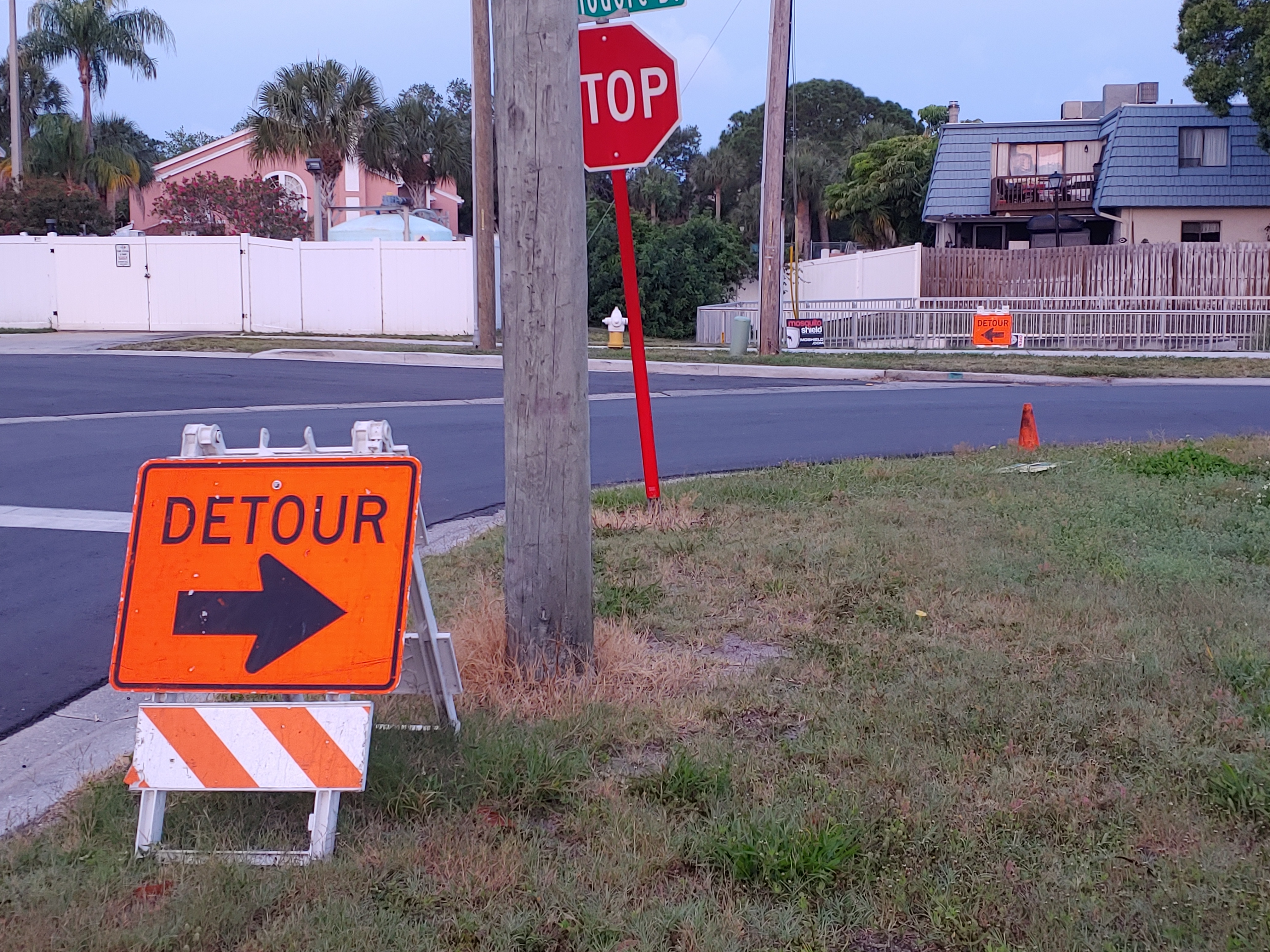
Detour Ahead. There. And there.

Look carefully. Yep, that’s a detour sign, pointing to the right at the T-intersection. And yes, across the street is another detour sign, pointing left. There are, as it happens, only two ways to choose here – right or left. Both appear to be detours. To where? From where?

A quarter-mile away, the road crews who neglected to pack up these signs (months have passed) also left behind a Detour sign with an arrow pointed up, as in, go straight ahead. That particular sign has been moved back and forth, one day pointed north, then south, and, most recently, either whimsically or horribly, as if the detour was to crash through someone’s side fence into their backyard.

Pity the unsuspecting rideshare driver who has to figure all this out. Eventually, there will be road work in our area again and we’ll all stupidly ignore the first detour signs, because we’ve learned to regard orange signs with arrows as signifying nothing.

There you go: life with crazy detours and places where there seems to be no right answer. At least, there seems to be no easy answer. It can be hard to know if a detour indicates something to be avoided or a relic or even a ruse.

Anyone new to the neighborhood would be stymied by the mixed messages, while the people who know the origin of the dueling detours shrug and ignore them – or, in some cases, get annoyed and move signs across the street.  There’s a clue: when a detour arises, ask questions; see how other people are responding to the apparent detour, and why.  On occasion, I see, in stores, the relics of the social distancing recommendations of 2020, those half-peeled away stickers on terrazzo floors. Like the road-sign-weary denizens of my area, shoppers ignore signs that used to be treated as if they’d come down from Mount Sinai.

There are detours that make sense, like when there’s a big hole in the road. No doubt you’ve gotten your share of detour signs from life. I’ve had mine. Some have kept me from disaster, and some turned out to be less about danger and more about someone else’s fears or agendas.  I’ve heard about many – and about so many people who figured out which detours were legitimate, and which were either relics or ruses.

Wishing you good adventures, and the wisdom to know relics from ruses, as well as to never be the person who puts up fake detour signs for others.